Quantum computing is often discussed in terms of qubits, error correction, processors and computational power. But as the technology moves closer to practical applications, another important question is emerging:
Who will actually use quantum computers?
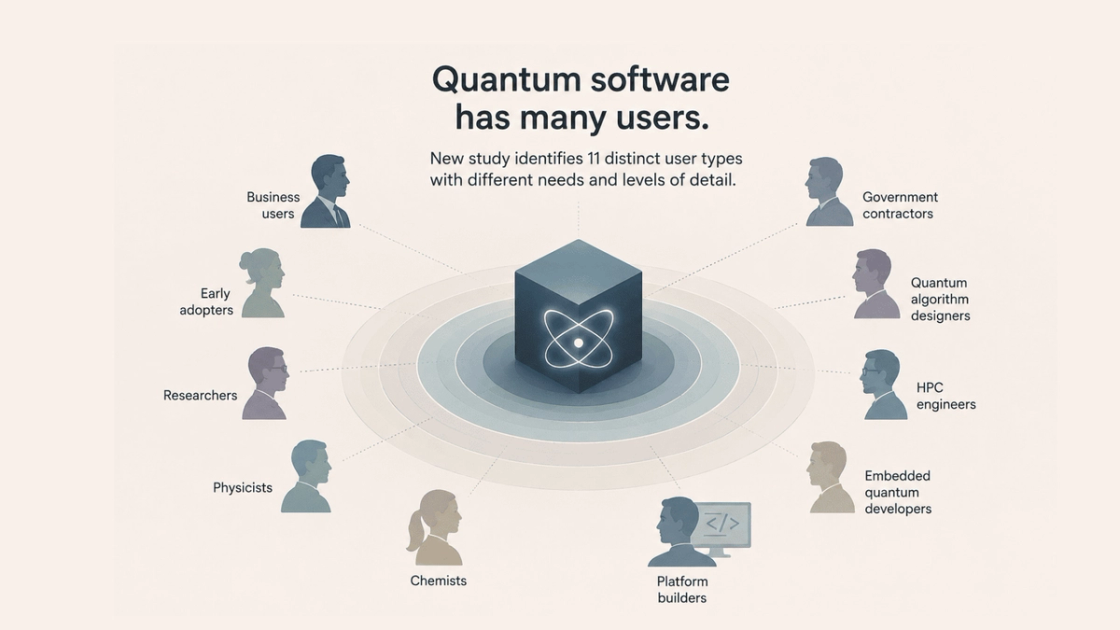
A recent study highlighted by The Quantum Insider explores this question by identifying 11 different types of potential quantum software users and stakeholders. The research suggests that the future of quantum computing will not be built around a single type of user or a single software interface. Instead, different users will require very different levels of access to quantum technology.
The 11 Types of Quantum Computing Users
The researchers identified 11 personas representing different stakeholders who may interact with quantum software.
1. Business Users
Business users are primarily interested in outcomes rather than quantum mechanics. They want to understand whether quantum computing can solve a business problem, improve performance, reduce costs or create new opportunities.
For these users, the underlying quantum hardware should largely remain invisible. The ideal experience could eventually look similar to using a conventional cloud computing service: define the problem, submit it, and receive useful results.
2. Early Adopters
Early adopters are companies and individuals looking to experiment with quantum computing before it becomes mainstream.
Their focus includes:
- Identifying useful quantum applications
- Developing new business models
- Testing quantum technologies
- Understanding potential competitive advantages
- Preparing for future quantum capabilities
They are likely to play an important role in moving quantum computing from research laboratories into commercial environments.
3. Government Contractors
Government contractors may have requirements that go beyond simply obtaining a result.
Security, transparency, traceability and verification can be particularly important. As a result, these users may require more visibility into how quantum software operates rather than relying entirely on black-box systems.
4. Physicists
Physicists represent one of the more technically intensive user groups.
They may use quantum computers to investigate physical systems, test theoretical models and perform simulations that are difficult to reproduce using conventional computing methods.
Their workflows can require direct interaction with mathematical models, quantum instructions and hardware capabilities.
5. Chemists
Chemistry is one of the areas frequently associated with quantum computing because molecules and materials are fundamentally governed by quantum mechanics.
Chemists could use quantum computing for applications such as:
- Molecular simulation
- Drug discovery
- Materials discovery
- Chemical reaction analysis
- Electronic structure calculations
For these users, software that translates a chemistry problem into a quantum-computing workflow could be much more valuable than requiring them to write quantum circuits manually.
6. Simulation Engineers
Simulation engineers work with computational models of physical and scientific systems.
Quantum computing could eventually become another computational resource within their existing simulation workflows, particularly for problems where classical approaches become computationally expensive.
Integration with classical simulation tools and high-performance computing environments will therefore be important.
7. Researchers
Researchers can occupy several levels of the quantum software stack.
Depending on their field, they may need a high-level interface to investigate a scientific question or lower-level access when developing new algorithms and computational techniques.
This makes researchers one of the more flexible user categories identified in the study.
8. Quantum Platform Builders
Platform builders develop the infrastructure that allows other people to use quantum computers.
This includes:
- Software development kits
- APIs
- Quantum programming environments
- Cloud interfaces
- Compilation tools
- Integration platforms
They essentially build the bridge between quantum hardware and the people who need to use it.
9. Quantum Algorithm Designers
Quantum algorithm designers need significantly more technical access.
Their work involves developing algorithms that exploit quantum mechanical effects to solve computational problems.
They need to understand both the algorithm and the capabilities and limitations of the underlying quantum hardware.
10. HPC Engineers
High-performance computing engineers will become increasingly important as quantum processors are integrated with classical computing infrastructure.
Rather than replacing classical computers, quantum processors are more likely to become specialized accelerators within hybrid computing systems.
HPC engineers will therefore need to understand how classical and quantum resources communicate, distribute workloads and optimize overall performance.
11. Embedded Quantum Developers
At the hardware-facing end of the spectrum are embedded quantum developers.
These developers work close to the underlying quantum system and may be responsible for system-level integration, control and communication between quantum and classical components.
Their requirements are fundamentally different from those of a business executive using a quantum application.
One Quantum Computer, Different Experiences
One of the most interesting conclusions from the study is that not everyone should interact with a quantum computer in the same way.
Consider two users.
A pharmaceutical scientist may simply want to provide a molecular problem and receive simulation results.
A quantum algorithm developer, meanwhile, may need access to circuit-level information, compilation processes and hardware characteristics.
Both are using the same underlying quantum technology, but their software experiences should be completely different.
This is where abstraction becomes critical.
Modern computing already works this way.
Someone using Microsoft Excel doesn’t need to understand how CPU transistors operate. A developer using a cloud API doesn’t need to manually configure every physical server involved in processing a request.
Quantum computing will need to develop similar layers of abstraction.
The study identifies a software ecosystem extending from end-user applications through quantum algorithms, programming languages, SDKs and compilation, down toward simulation and hardware development.
From Qubits to Business Results
As quantum computers mature, users may gradually become less concerned with the underlying quantum technology.
Instead of asking:
How many qubits does this system have?
business customers may eventually ask:
- How much does it cost?
- How quickly can it solve my problem?
- How accurate are the results?
- How does it compare with classical computing?
- What business value does it create?
That would represent a major transition for the industry.
Quantum computing would move from being a technology that people need to understand into a technology that people simply use.
What This Means for Industries
The 11 personas identified in the research also provide an interesting perspective on how quantum computing could enter different industries.
Pharmaceuticals
Scientists could interact with quantum systems through chemistry and molecular simulation software rather than directly programming quantum circuits.
Finance
Financial analysts and risk teams could eventually use quantum-enabled optimization and simulation through higher-level financial applications.
Artificial Intelligence
AI researchers and engineers may use quantum processors as specialized computational resources within hybrid AI and classical computing workflows.
High-Performance Computing
HPC engineers could integrate quantum processors with classical supercomputers, creating hybrid architectures where each technology performs the workloads it handles best.
Final Thoughts
The question “Who will actually use quantum computers?” may ultimately be just as important as “How powerful will quantum computers become?”
The 11 personas identified by this research provide a useful framework for thinking about that future.
Quantum computing will likely become successful when its complexity is hidden behind intuitive software, industry-specific applications and familiar computing workflows. The winners may not simply be the companies that build the most powerful quantum processors.
They may be the companies that figure out how to turn quantum capability into something people can actually use.
Source
This article is based on reporting by The Quantum Insider and the research paper “Know Your Qubits, Know Your Users: Personas for Quantum Software.”
Original news article:* *The Quantum Insider Who Will Actually Use Quantum Computers? Study Identifies 11 User Types
Research paper:* Know Your Qubits, Know Your Users: Personas for Quantum Software, arXiv:2608.18598.*
Editorial note: This article is an independent commentary and summary of the reported research and does not reproduce the original article.