Quantum computers and quantum simulators are becoming increasingly powerful, allowing researchers to explore complex physical problems that can be extremely difficult for conventional computers.
But as quantum systems grow larger and more sophisticated, an important question becomes harder to answer:
How do we know that a quantum computer’s result is actually accurate?
A new research breakthrough from scientists at the Technical University of Munich, the University of Innsbruck, and collaborating institutions could provide an important part of the answer. Researchers have developed a method that can experimentally determine how accurately a quantum simulator is performing and attach numerical error limits to its results.
The work could become an important step toward making quantum simulations more measurable, verifiable, and trustworthy.
The Verification Problem in Quantum Computing
Quantum computers operate in an environment where noise, imperfections, and interactions with the surrounding environment can affect their behavior.
For relatively small quantum systems, researchers can sometimes verify a quantum result by comparing it with a calculation performed on a conventional computer.
But this approach becomes increasingly difficult as quantum systems grow. If a quantum simulator is being used to investigate a problem that is already beyond the practical capabilities of classical computing, researchers cannot simply calculate the same problem classically and compare the answers. This creates a fundamental challenge:
If the classical computer cannot independently reproduce the answer, how can we determine whether the quantum result is correct?
The new research addresses this problem by focusing on the physical behavior of the quantum simulator itself.
Measuring How the Quantum System Actually Behaves
Rather than assuming that a quantum simulator behaves exactly according to its theoretical model, the researchers use experimental measurements to characterize the system.
These measurements provide information about the interactions within the quantum system as well as fluctuations and sources of noise. The researchers can then build a model of the actual system and determine how the uncertainties in that model influence the final simulation.
The result is more than a single numerical answer.
Instead, the quantum simulation can produce a result accompanied by an error margin that indicates how much confidence researchers should place in it.
Demonstrated With 51 Ions
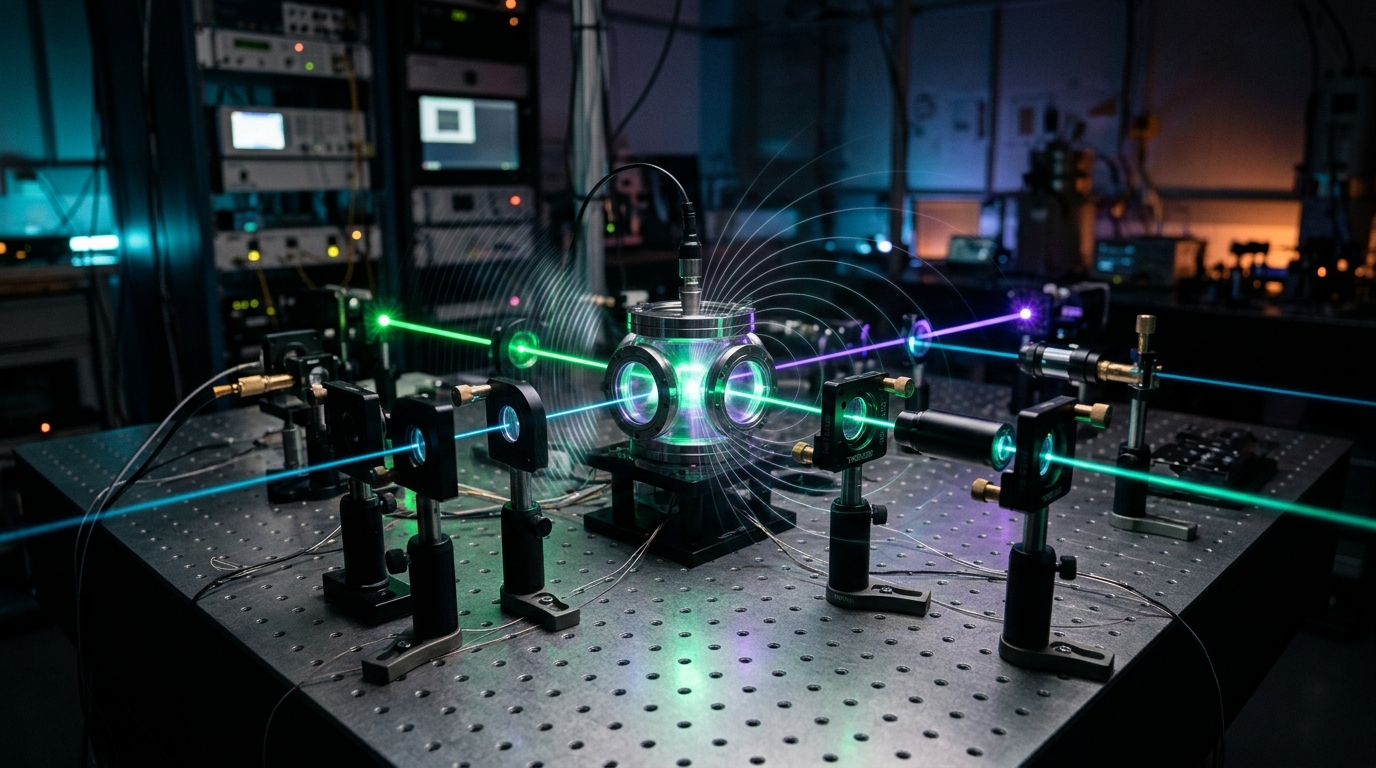
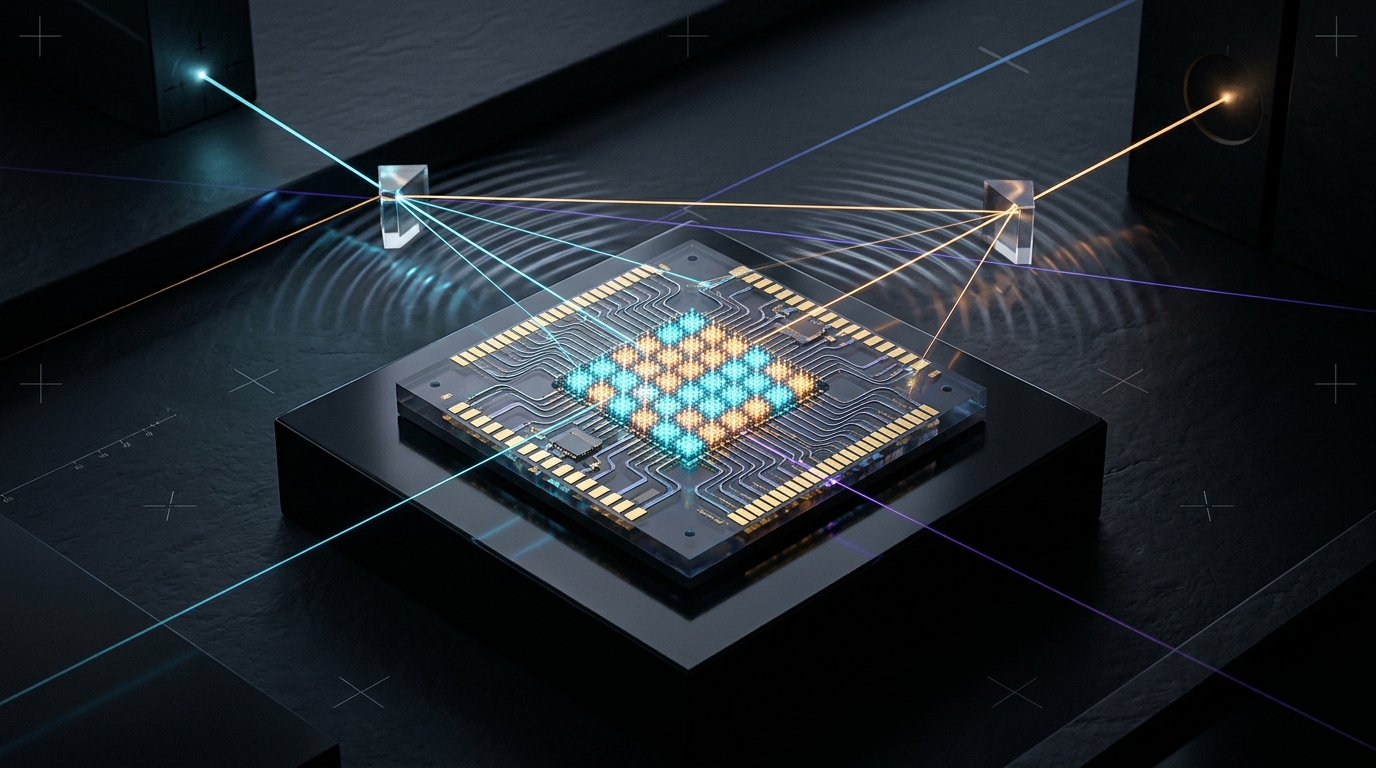
The team tested the approach using an ion-trap quantum simulator. The researchers initially worked with a system containing 10 ions, where conventional computers could still calculate the system’s behavior. This allowed them to compare the experimentally derived model and its predicted error limits with independent calculations.
After validating the method, the researchers extended it to a system containing 51 ions. The experiment demonstrated that the approach could be applied to significantly larger quantum systems while still providing information about the uncertainty of the resulting simulations.
This is particularly significant because verification becomes more difficult as quantum systems scale.
Why Error Bars Matter for Quantum Computing
In many areas of science and engineering, measurements are not presented simply as a number. They are accompanied by an uncertainty or error range. Quantum computing has a similar challenge.
A quantum device might produce a result that looks impressive, but without knowing the uncertainty associated with that result, it can be difficult to determine how reliable the result actually is. A quantitative error bound could therefore become an important tool for evaluating quantum systems.
For example, researchers could potentially distinguish between:
- A quantum result that is highly precise
- A result with significant uncertainty
- A result whose uncertainty is too large to support a useful conclusion
This could make quantum simulations easier to evaluate and compare.
Why This Matters for the Future of Quantum Computing
Quantum computing is moving from laboratory experiments toward increasingly practical applications in areas such as materials science, chemistry, optimization, drug discovery, and high-performance computing.
For these applications, simply obtaining a quantum result will not be enough. Researchers and industry will need to know:
Can we trust the result?
Methods that provide experimentally determined uncertainty could help answer that question. As quantum processors and simulators continue to scale, independent verification may become one of the most important parts of the quantum computing ecosystem.
The future of quantum computing may therefore depend not only on building larger systems with more qubits, but also on developing better ways to understand, validate, and quantify what those systems are actually telling us.
The Bigger Picture
The latest research does not eliminate errors from quantum computing. Instead, it tackles a more fundamental problem: understanding and quantifying those errors. That distinction is important.
A reliable quantum computer is not necessarily one that produces a perfect answer every time. It is a system whose behavior and uncertainties can be characterized well enough that researchers can determine whether its results are meaningful.
The ability to attach experimentally supported error limits to quantum simulations could therefore represent an important step toward more trustworthy quantum computing. As quantum systems become larger and classical verification becomes less practical, knowing how much we can trust a quantum result may become just as important as obtaining the result itself.
Source
This article is based on research reported by SciTechDaily and the underlying study published in Physical Review X:
“Bounded-Error Quantum Simulation via Hamiltonian and Lindbladian Learning”
Authors: Tristan Kraft, Manoj K. Joshi, William T. Lam, Tobias Olsacher, Florian Kranzl, Johannes Franke, Lata Kh Joshi, Rainer Blatt, Augusto Smerzi, Daniel Stilck França, Benoît Vermersch, Barbara Kraus, Christian F. Roos, and Peter Zoller.
Published: August 13, 2026, Physical Review X.