Much of the public conversation surrounding quantum computing centers on qubit counts inside a single chip or cryostat. However, scaling monolithic processors introduces severe physical bottlenecks, including thermal crosstalk, microwave routing congestion, and control-line attenuation. To scale beyond isolated physical packages, quantum information systems require a dependable method for transferring quantum states between distinct hardware nodes.
Recent progress in photonic quantum engineering highlights two practical paths forward. The first involves deploying photonic quantum hardware into educational and research institutions, broadening real-world hardware access. The second demonstrates deterministic optical interconnects linking heterogeneous physical qubits across light-based communication channels.
Both achievements reinforce why photons are uniquely positioned in the quantum computing roadmap: they serve not merely as computational qubits within optical processors, but as the physical medium connecting distributed quantum networks.
Quandela Deploys MosaiQ Photonic Hardware to Vietnam
On 22 October 2026, French photonic quantum computing company Quandela and Vietnamese quantum firm Quanova announced a formal partnership to install a Quandela MosaiQ photonic quantum system at Quang Trung University in Vietnam.
This installation marks a notable shift in how quantum hardware enters academic environments:
- Accessible Operating Environment: Unlike superconducting or spin-qubit processors that demand multi-stage dilution refrigerators running near absolute zero (15 millikelvin), room-temperature photonic quantum computing operates primarily with optical circuits at room temperature, using compact, localized cooling only for single-photon emitters or detectors.
- Hardware-in-the-Loop Education: Providing university researchers with direct access to physical quantum processors allows students and engineers to benchmark quantum algorithms against real optical losses and detector noise, moving past idealized numerical simulations.
- Regional Ecosystem Growth: Placing quantum systems in emerging technology hubs decentralizes quantum research, fostering specialized algorithmic research and optical engineering talent outside traditional computing labs.
Deploying hardware at universities does not imply that commercial quantum advantage has arrived for general-purpose workloads. Instead, it provides the essential testbed for calibrating photonic control electronics, optimizing gate fidelity, and developing the systems engineering expertise necessary for the next generation of quantum hardware.
Read the official deployment announcement.
IonQ Links Trapped Ions and Solid-State Quantum Memory via Light
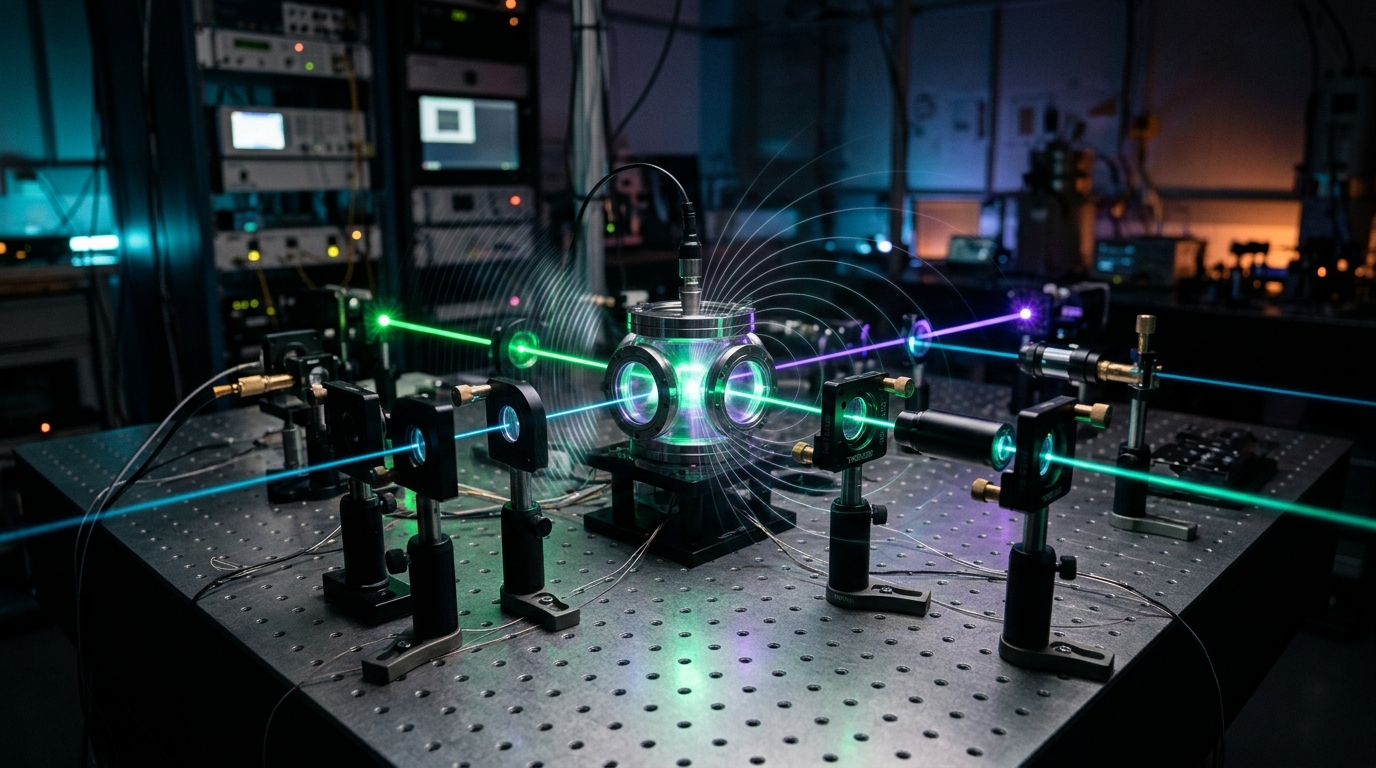
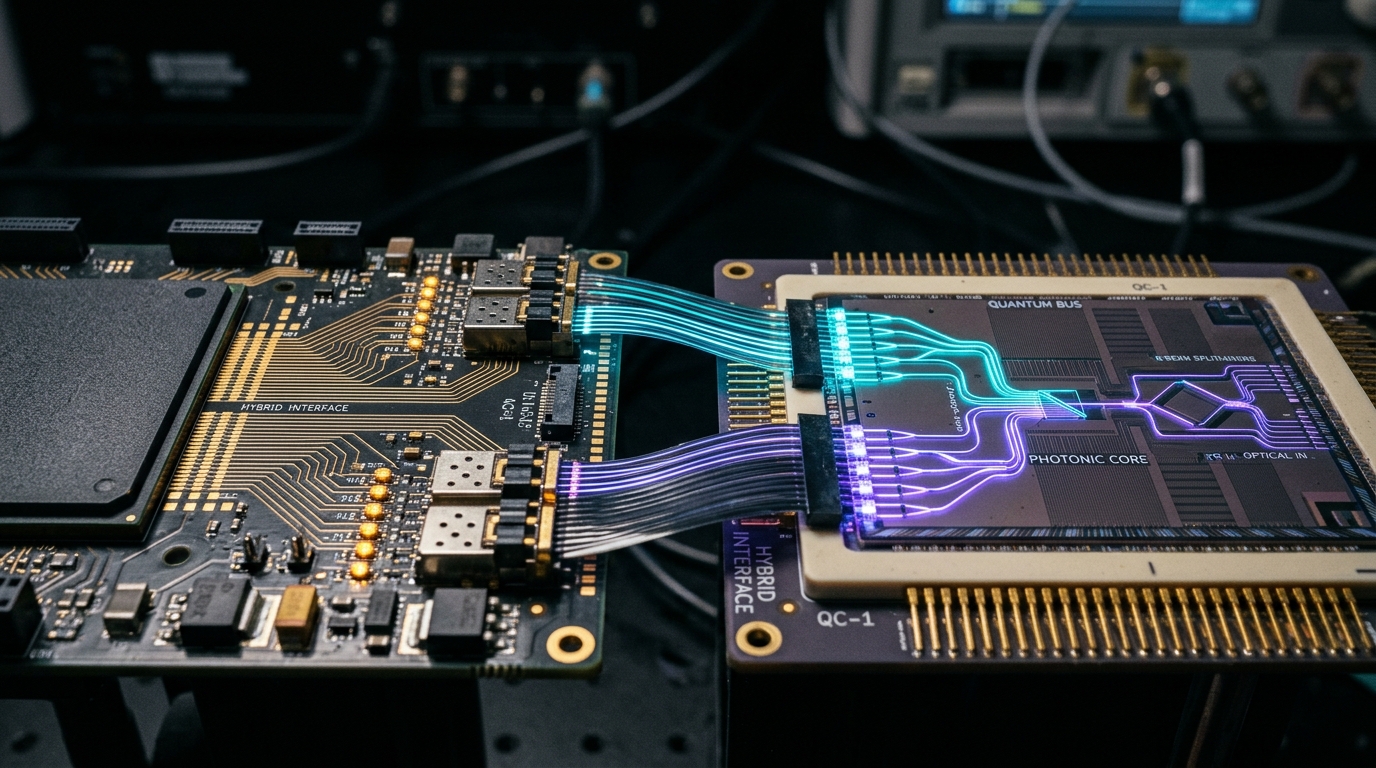
Scaling quantum computing to fault-tolerant levels will likely require modular clusters of quantum processors connected through high-speed optical links, mirroring the way classical high-performance computing (HPC) clusters rely on optical InfiniBand fabric.
On 9 October 2026, IonQ demonstrated a major milestone in heterogeneous quantum networking: generating more than 1,000 entanglement events per second across a photonic interconnect linking a trapped-ion qubit with a solid-state quantum memory.
This experiment addresses several long-standing bottlenecks in distributed quantum computing:
- Bridging Heterogeneous Modalities: Trapped-ion qubits provide long coherence times and high single-qubit gate fidelities, while solid-state systems excel at compact quantum memory storage. Bridging these distinct physical architectures requires converting atomic fluorescence into telecom-compatible photons without destroying quantum phase information.
- Entanglement Rates Exceeding Memory Decoherence: Generating more than 1,000 entangled pairs per second is a vital operational threshold. To execute distributed quantum logic gates or quantum error correction routines, the rate of entanglement generation between separate nodes must outpace the natural decoherence rate of the quantum memories storing those states.
- Foundation for Quantum Repeaters: Direct transmission of single photons through optical fiber is limited by exponential attenuation (roughly 0.2 dB/km at telecom wavelengths). High-rate light-matter interfaces form the core building block of quantum repeaters, which store and purify entanglement to bridge multi-node quantum networks across metropolitan distances.
Read IonQ’s technical announcement.
Why Photons Are Essential for Quantum Networks
In solid-state quantum platforms (including superconducting circuits, quantum dots, and silicon spin qubits), quantum information is encoded in localized electron or nuclear spins, or macroscopic flux states. While these stationary qubits excel at local gate operations, their states cannot travel outside their cryogenic shields without succumbing to thermal decoherence.
Photons, by contrast, possess physical properties that make them ideal carriers of quantum information:
- Negligible Thermal Coupling: At optical frequencies (roughly 200 THz in the telecom C-band), the energy of a single photon is orders of magnitude greater than ambient thermal noise ($k_B T$). Optical quantum states can traverse optical waveguides, free space, and fiber cables without thermal excitation.
- Speed-of-Light Propagation: Photons travel at the speed of light in optical fibers, providing the lowest latency possible for distributed state transfer between quantum processors.
- Dual Functionality in Architecture: Light can serve as the computing medium itself (photonic quantum computing) or as the low-loss interface linking stationary matter-based QPUs (quantum interconnects).
Engineering light-based quantum systems still demands rigorous control over optical transmission losses, mode-matching between single photons, and detector quantum efficiency. Photonic architectures continue to refine these parameters across two primary approaches:
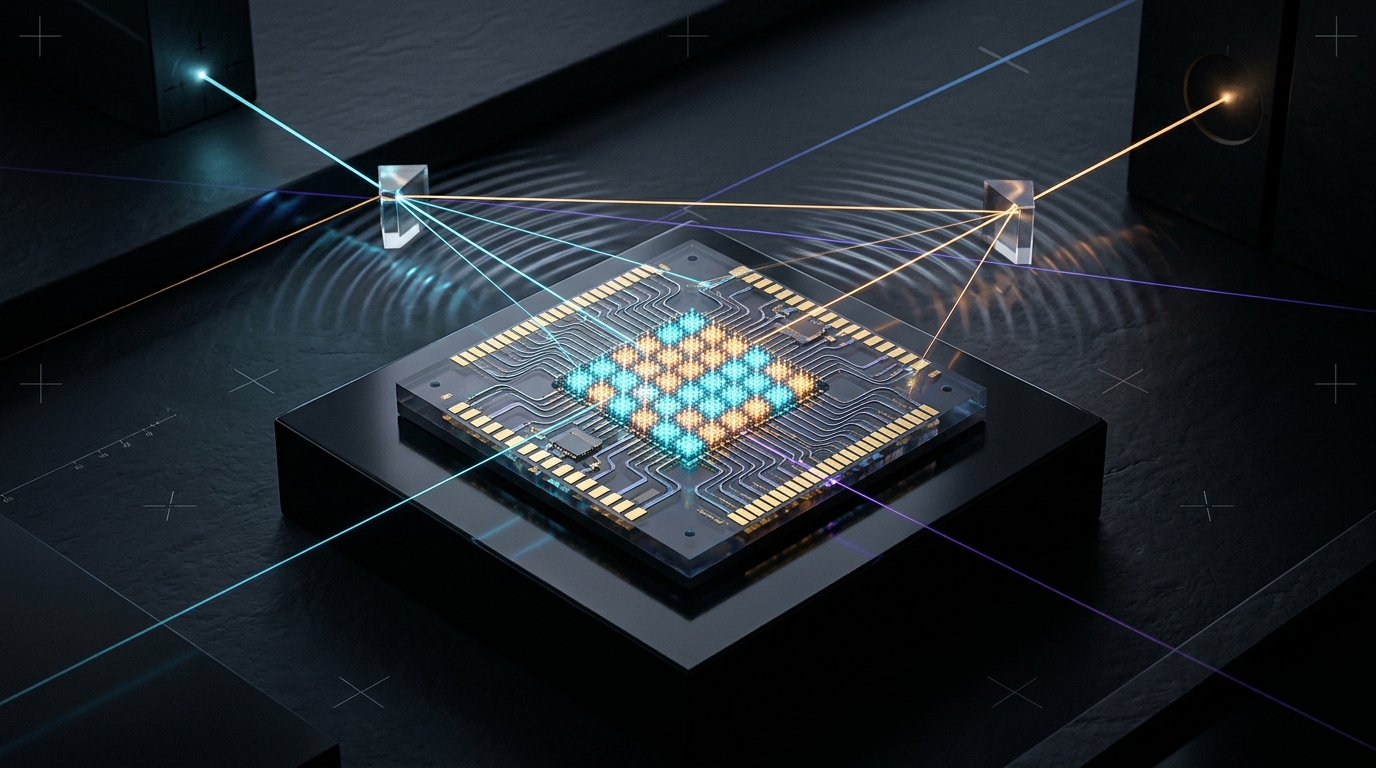
- Discrete-Variable (DV) Optics: Encoding quantum information into individual photons (such as polarization or path modes). This approach requires high-purity single-photon sources and probabilistic quantum gates, relying on post-selection and measurement-based protocols.
- Continuous-Variable (CV) Optics: Encoding quantum states into continuous field quadratures of optical electromagnetic modes. By using squeezed states of light and optical parametric oscillators, CV platforms generate high-dimensional entangled states deterministically at ambient temperatures.
From Monolithic Chips to Distributed Quantum Data Centers
The historical trajectory of classical supercomputing shifted decades ago from trying to build an infinitely fast single processor to linking thousands of processors across high-throughput network fabrics. Quantum computing is now entering a similar transition.
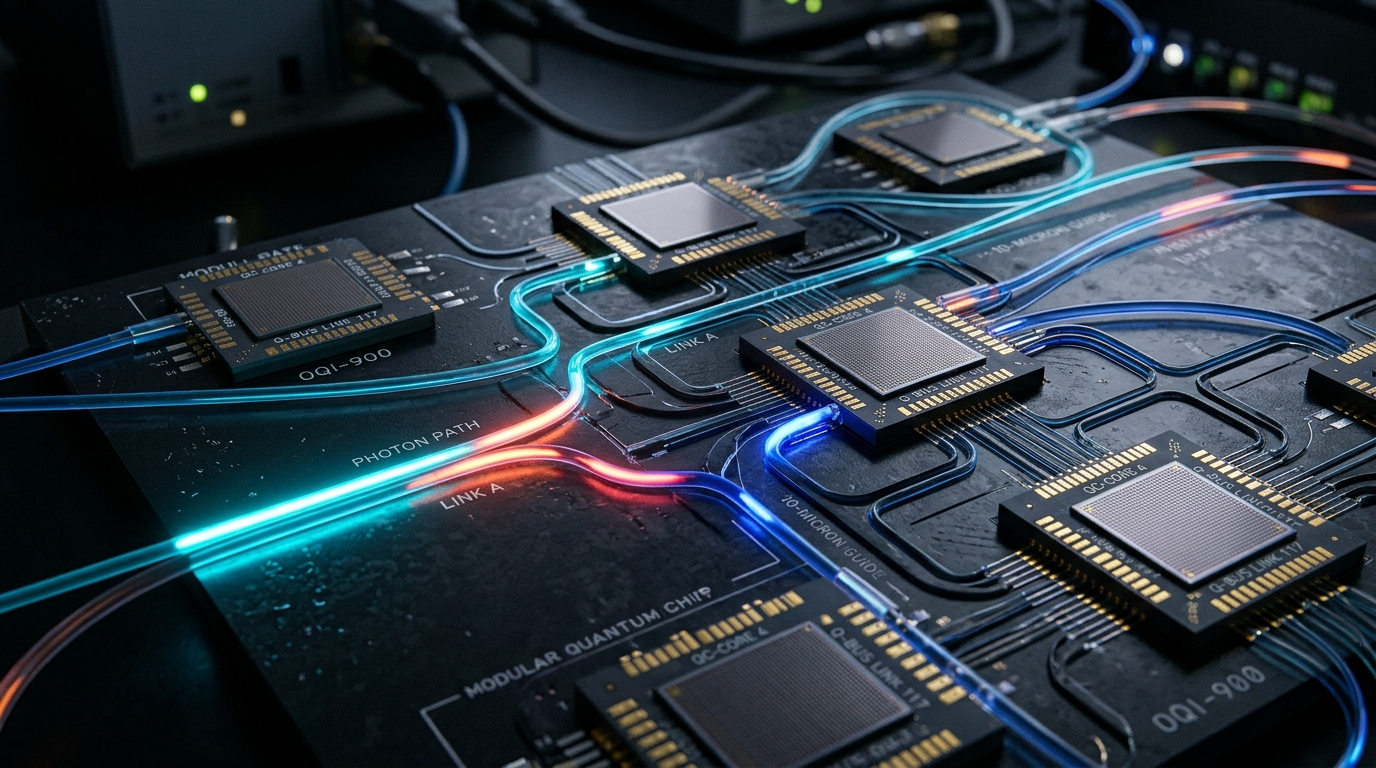
Monolithic scaling encounters rigid thermodynamic and physical limits. Expanding a single quantum processor to millions of physical qubits requires impossible cryogenic cooling capacity and unmanageable wiring densities. The viable path to utility-scale quantum computation lies in modular architectures: individual quantum processor units (QPUs) housed in separate chassis, communicating coherently via optical interconnects.
Optical quantum technologies provide both halves of this equation:
- High-bandwidth quantum interconnects linking disparate matter qubits across server racks.
- Native photonic processors capable of executing linear and non-linear optical transformations directly at room temperature.
The OJANVU Perspective
At OJANVU Quantum Labs, our research focuses on room-temperature photonic quantum computing using continuous-variable quantum optics. We view developments like Quandela’s hardware deployment in Vietnam and IonQ’s high-rate photonic interconnect as validation of a broader reality: optics and photonics are not auxiliary components in quantum computing, they are central to how quantum technology scales into real-world data centers and toward a functional quantum internet.
The evolution of quantum computing will ultimately be shaped by reproducibility, system interconnectivity, and seamless integration with existing data center infrastructure. Demonstrating stable light-matter interfaces and expanding physical hardware access are necessary steps toward that distributed future.