Quantum computing is entering a new phase. For years, the industry has concentrated on building increasingly powerful processors, improving qubit quality and developing better error-correction techniques. Yet an important question remains: what kind of physical architecture will make large-scale quantum computing practical?
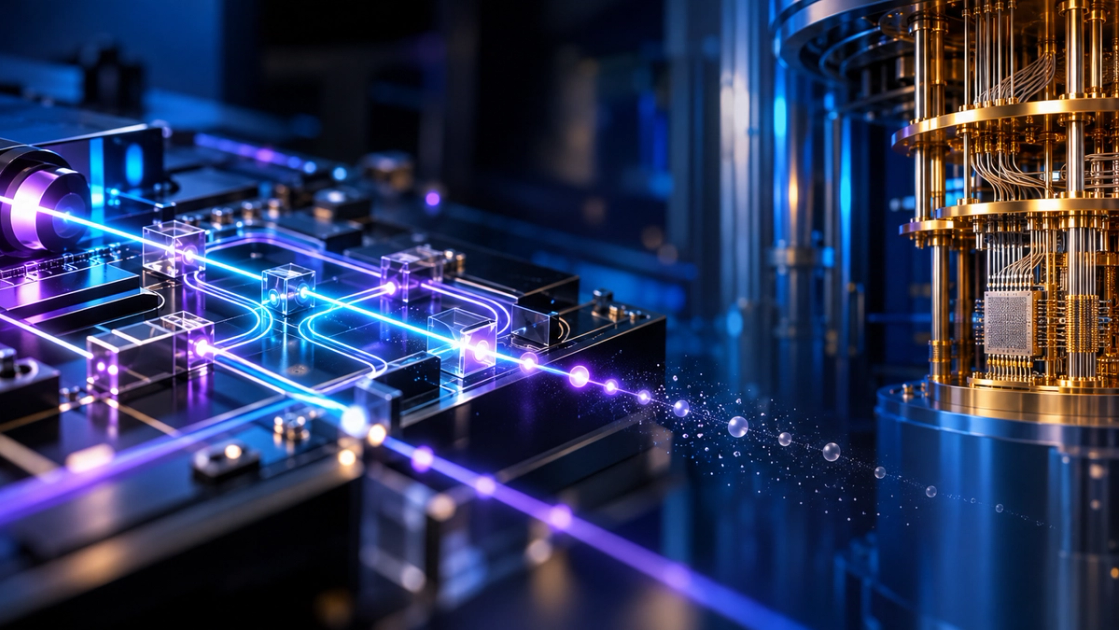
Superconducting quantum computers have made significant progress, but their operation depends on sophisticated cryogenic systems that maintain quantum processors at temperatures close to absolute zero. Photonic quantum computing offers a different approach. Instead of storing and manipulating quantum information primarily in superconducting electrical circuits, it uses the quantum properties of light.
This difference could have important consequences for the scalability, connectivity and deployment of future quantum computers.
However, photons introduce their own engineering challenge: what happens when a photon carrying quantum information is lost?
Understanding this problem is essential to understanding both the promise and the future of photonic quantum computing.
The challenge of building quantum computers
Quantum computers rely on physical systems that preserve and manipulate delicate quantum states. These states can encode information in ways that are fundamentally different from classical bits.
The difficulty is that quantum information is vulnerable to errors. Interactions with the environment, imperfect operations and measurement errors can compromise a computation before it finishes.
Different quantum computing architectures face different versions of this problem.
Superconducting quantum processors use electrical circuits containing Josephson junctions. These circuits must be cooled to extremely low temperatures to maintain the operating conditions required for superconductivity and coherent quantum operations. The associated cryogenic infrastructure requires specialised refrigeration, thermal management, wiring and control electronics.
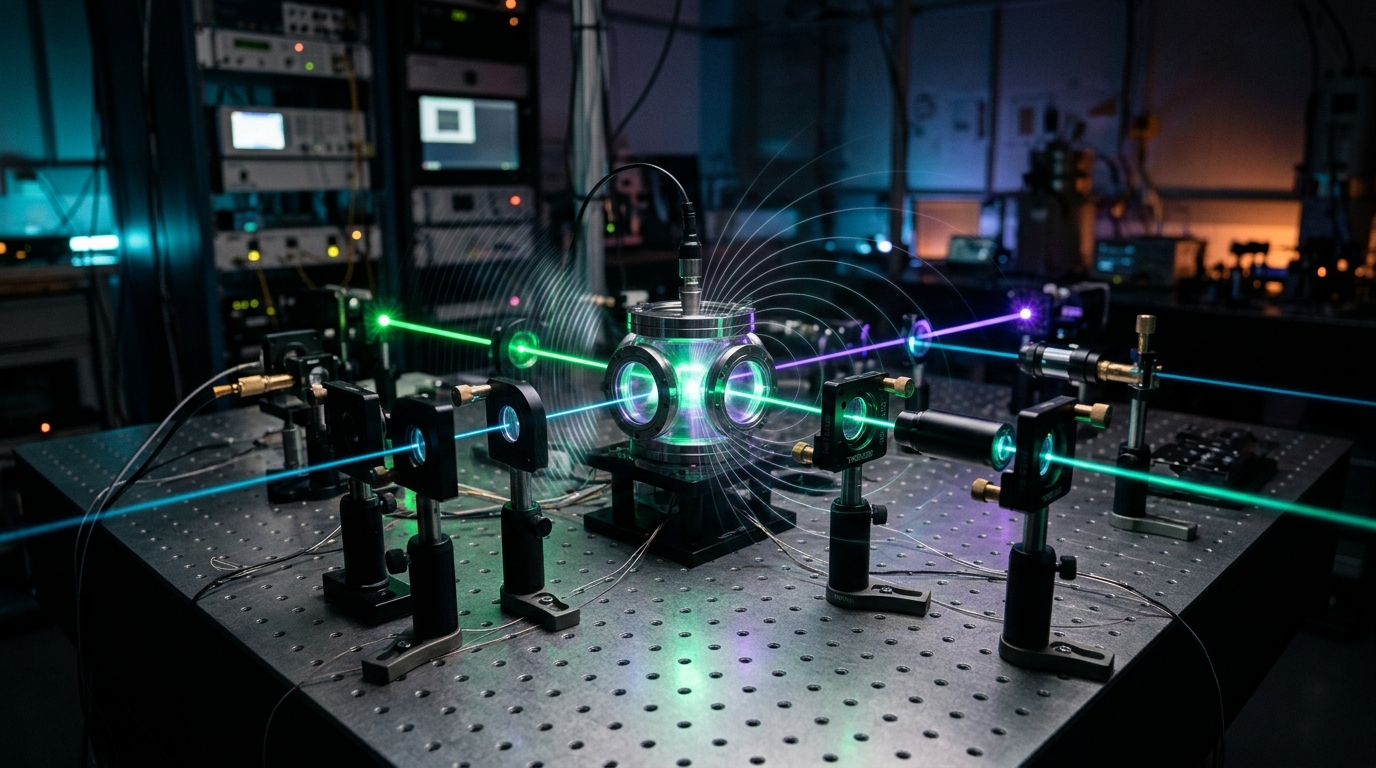
Photonic quantum computers approach the problem differently. Their computational resources are encoded in optical modes, using properties such as the path, time bin, polarisation or field quadratures of light.
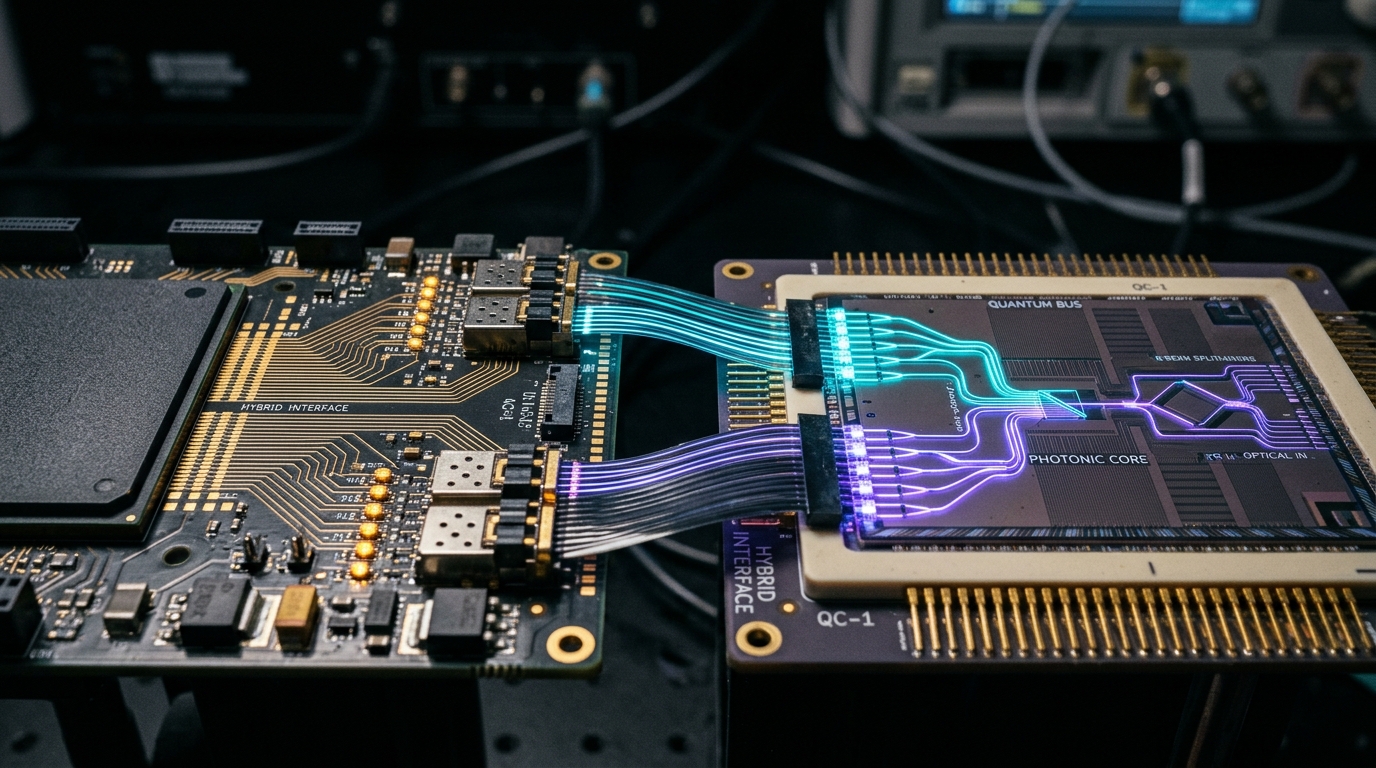
Photons interact only weakly with their surroundings in many relevant settings, making them attractive carriers of quantum information. Optical technologies can also be integrated into photonic chips and connected through fibre-optic networks.
These properties offer a compelling alternative, but they do not eliminate the need for precise control, error correction or reliable hardware.
Why photonic quantum computing has a different scaling opportunity
One of the most attractive features of photonic quantum computing is its potential to reduce dependence on large cryogenic systems.
Many photonic components, including optical sources, waveguides and control elements, can operate at or near room temperature. This creates opportunities to build room-temperature photonic quantum computers that operate without the extensive dilution refrigeration required by superconducting processors.
The distinction is important: some photonic architectures still use cryogenic detectors or other specialised components. Photonic quantum computing should therefore not be described as universally cryogenics-free.
Its advantage is architectural. The optical processing components and quantum information carriers can often operate under conditions that are much less demanding than those required by superconducting qubits.
Another advantage is connectivity.
Optical signals can travel through fibres and integrated waveguides, providing a natural foundation for connecting separate modules. As quantum computers grow, connecting multiple processors may become just as important as increasing the number of computational elements within an individual processor.
Photonic architectures could make modular quantum computing and quantum networking easier to engineer because light is already the medium used by modern telecommunications infrastructure.
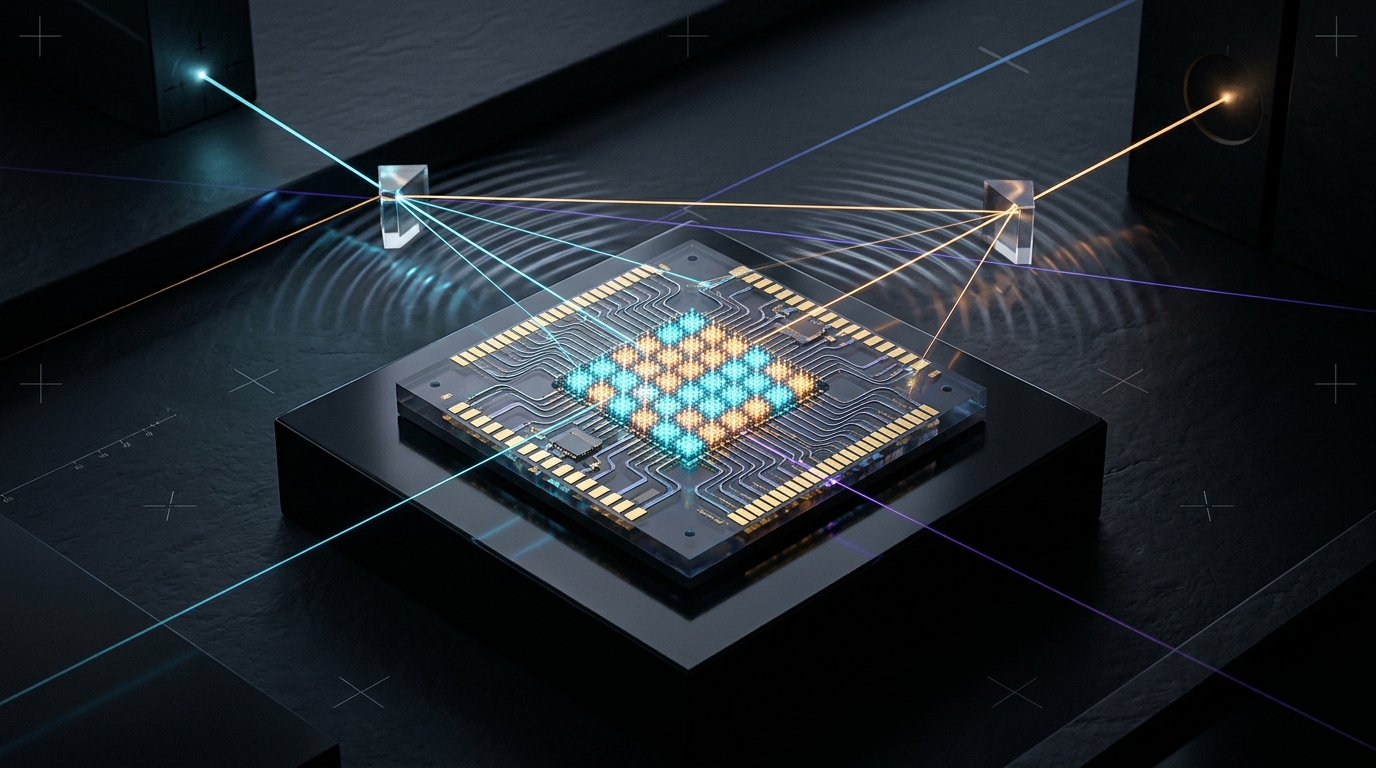
Integrated photonics also offers a pathway towards compact optical circuits manufactured using techniques developed for semiconductor and photonic-chip industries.
These advantages make photonics an important candidate for scalable quantum computing. They do not, however, guarantee that a photonic processor will outperform a superconducting processor on every workload.
The photon-loss problem
Photons are excellent carriers of quantum information, but they cannot carry that information to a detector if they disappear along the way.
Photon loss can occur when light passes through optical fibres, waveguides, switches, couplers and other components. Sources may fail to produce photons when expected, while detectors may fail to register photons that arrive.
Every component introduces the possibility of losing information.
In a large optical circuit, even small losses can accumulate across many operations. A photon that disappears before a measurement may leave the system without the information required to complete a computation correctly.
This is fundamentally different from simply making a conventional processor run more slowly. Quantum algorithms depend on the preservation of particular quantum states and correlations. Losing the relevant information can undermine the computation itself.
Consider an optical circuit in which a photon must pass through several components. If each component transmits only a fraction of the incident light, the probability of successful transmission decreases as the number of components increases.
For a simplified sequence of independent optical elements with transmission probabilities (T_1,T_2,\ldots,T_n), the probability that a photon survives the entire path is
[ P_{\mathrm{survival}}=\prod_{i=1}^{n}T_i ]
If every component has the same transmission probability (T), this becomes
[ P_{\mathrm{survival}}=T^n ]
The implication is straightforward: improving individual components can have a substantial effect on the reliability of an entire optical system.
For scalable photonic quantum computers, reducing optical loss is not merely a component-level optimisation. It is a system-level requirement.
Why photon loss matters for fault-tolerant quantum computing
A useful quantum computer must do more than produce correct results in small experiments. It must execute sufficiently long computations while controlling the accumulation of errors.
Fault-tolerant quantum computing addresses this challenge through quantum error correction. Information is encoded across a larger physical system so that certain errors can be detected and corrected without directly measuring and destroying the encoded quantum information.
Photonic systems can use error-correcting codes, redundant encodings, additional optical resources and carefully designed measurement protocols to mitigate loss.
However, these methods require resources. Depending on the architecture, they may increase the number of photons, optical components, measurements and control operations needed to perform a computation.
The result is a central engineering trade-off: a photonic quantum computer may benefit from optical connectivity and reduced cryogenic requirements, but its practical scalability depends on controlling the loss and overhead introduced by its implementation.
This is why low-loss waveguides, efficient quantum light sources, high-performance detectors and reliable optical switching are so important.
A processor with a large theoretical computational capacity is not necessarily useful if too much of its quantum information disappears before the computation is completed.
Photonic quantum computing versus superconducting quantum computing
Superconducting and photonic quantum computing represent different approaches to the same long-term objective: building reliable quantum processors capable of solving useful problems.
Superconducting systems benefit from strong controllable interactions, mature experimental techniques and substantial progress in processor engineering. Their principal engineering challenges include maintaining coherence, improving gate fidelity, controlling large numbers of qubits and managing increasingly complex cryogenic infrastructure.
Photonic systems offer a different set of strengths. Light is naturally suited to optical communication, and photonic circuits can potentially be integrated into compact, interconnected modules. Many components can operate without the need for a dilution refrigerator.
Their main challenges include photon loss, efficient generation of suitable quantum states, detector performance and implementing reliable interactions or measurement-based operations.
Neither platform has eliminated the difficulty of fault-tolerant scaling.
The important distinction is that photonic quantum computing offers a different route to scaling, one that could make networking and deployment more practical while shifting a substantial part of the engineering challenge towards optical efficiency and resource management.
If those challenges can be addressed, photonic architectures could become particularly attractive for quantum systems that need to connect multiple processing modules or integrate closely with optical communication infrastructure.
Can photonic quantum computers operate at room temperature?
This question requires a distinction between the operating temperature of a quantum processor and the operating temperature of every component in its system.
Many optical components can function at room temperature. Some photonic quantum architectures can therefore perform important parts of their computation without cooling the optical processor to millikelvin temperatures.
However, certain photon detectors and other specialised components may require cryogenic operation. The requirements depend on the architecture, the detector technology and the desired performance.
The long-term opportunity is not necessarily to eliminate every cooling system from every quantum computer. It is to avoid imposing extensive cryogenic requirements on components that do not need them.
This could reduce infrastructure complexity, create more flexible deployment options and change the economics of scaling quantum hardware.
A credible room-temperature quantum computing architecture must demonstrate its operating conditions at the system level, including the source, processing circuit, detectors, control electronics and error-correction infrastructure.
The distinction between a room-temperature optical processor and a completely room-temperature quantum computer is essential when evaluating technological claims.
What must happen next?
For photonic quantum computing to realise its potential, several developments must progress together.
Optical circuits must minimise propagation and coupling losses. Quantum light sources must generate suitable states with high efficiency and reliability. Detectors must accurately measure the required optical states. Quantum error-correction schemes—particularly bosonic quantum error correction and GKP encoding—must operate with realistic physical resources rather than idealised assumptions.
Researchers must also demonstrate that complete systems can perform increasingly demanding computations while maintaining acceptable error rates.
These goals cannot be achieved by improving a single component in isolation. The source, circuit, detector, encoding and control architecture must be designed as parts of one system.
The most promising route forward is therefore a combination of better optical engineering, improved quantum-state preparation, efficient measurement and architecture-aware error correction.
Reducing photon loss is central to this effort because every improvement can help preserve more of the information that a quantum computation depends on.
Conclusion
The future of quantum computing may not depend on one architecture replacing every other approach. Different technologies may serve different applications, and their relative strengths will become clearer as reliable, fault-tolerant systems emerge.
Nevertheless, photonic quantum computing offers a compelling opportunity.
Its compatibility with optical communication, potential for integrated manufacturing and reduced dependence on large cryogenic systems for many components make it an important candidate for scalable quantum computing.
The challenge is to ensure that these advantages survive contact with the realities of large-scale hardware. Photon loss remains one of the most important obstacles because it directly affects the reliability, resource requirements and scalability of optical quantum processors.
Solving this problem could bring photonic quantum computing closer to practical deployment and help establish new approaches to building interconnected quantum systems.
At OJANVU Quantum Labs, we believe the future of quantum computing must be evaluated not only by the number of qubits a processor can claim, but also by the physical resources required to operate it, the reliability of its computation and the practicality of scaling its architecture.
The next major advance in quantum computing may come not simply from building more qubits, but from finding better ways to preserve and use quantum information.